




Building the circular economy through aligned government priorities
How the African Development Bank channels government-led strategic priorities to build a continental ecosystem for circular market creation.
Listen to the story
Building the circular economy through aligned government priorities
Institutional Profile
African Development Bank (AfDB) Group
Founded
1964
Headquarters
Abidjan, Côte d'Ivoire
Footprint
The premier multilateral development bank in Africa, driving economic development and social progress across 54 regional member countries. Hosts the Secretariat for the Africa Circular Economy Alliance (ACEA) and manages the Africa Circular Economy Facility (ACEF), a multi-donor trust fund now in a five-year scaling period.
Transforming political appetite into institutional change
In a large multilateral development bank, change does not happen by magic. It requires specific, dedicated vehicles to disrupt business-as-usual lending. For the African Development Bank, the turning point came from outside the bank, from a rising, unified demand by its member states. This intention became clear in October 2019, when a combined delegation of African governments decided to attend the World Circular Economy Forum in Finland, proving their shared appetite in the circular economy as an inclusive green growth strategy.
The AfDB's leadership realized that this geopolitical shift represented a huge opportunity to create new markets. However, the bank's traditional risk setup was designed for traditional linear business models. Without a dedicated structural bridge, the growing political interest of these governments would remain disconnected from actual capital deployment, and circular economy projects would stay on the sidelines.
The geopolitical inflection point
Fragmented national agendas converged into one continental ask
A non-exhaustive view of the delegation, the political signal was the unity, not the headcount.
World Circular Economy Forum
A combined delegation of African governments arrives unified, proving a shared appetite for the circular economy as a green-growth strategy. The bank's read : sovereign alignment is a force financiers can use.
Without a dedicated structural bridge, political interest stays disconnected from actual capital deployment.
Two engines for one continental ecosystem
The AfDB's core strategy relied on a key insight: when multiple governments align on a strategic priority, they create a strong external force that financiers can use to lower risks across whole markets. Rather than waiting for individual projects to surface, the bank positioned itself to build a bottom-up, pan-African circular economy network from the ground up. This strategy was put into action through 2 main collaborative pillars.
ACEA, the Policy Engine: the bank took on the role of host and Secretariat for the Africa Circular Economy Alliance (ACEA), a government-led platform that has grown to over 20 African nations. To focus its efforts, the alliance uses a clear market analysis centered on 5 “Big Bets” for the continent: food systems, packaging, the built environment, electronics, and fashion and textiles. Through this focus, ACEA turns high-level political alignment into concrete national circular economy roadmaps, which were recently launched in countries like Benin and Chad.
ACEF, the Financial Catalyst: to back this policy work with capital, the bank set up the Africa Circular Economy Facility (ACEF) in 2022. Supported by the Governments of Finland and Italy, the Nordic Development Fund, and corporate partners including the Coca-Cola Foundation, ACEF operates as an internal startup within the bank. Its mandate is clear: use technical support to create an enabling policy environment on one side, and help private circular businesses become ready for investments on the other.
The two engines · One continental ecosystem
ACEA powers policy alignment. ACEF deploys capital around it.
ACEA · over 20 member countries
The government-led alliance now spans over 20 African nations, the political base ACEF deploys capital around.
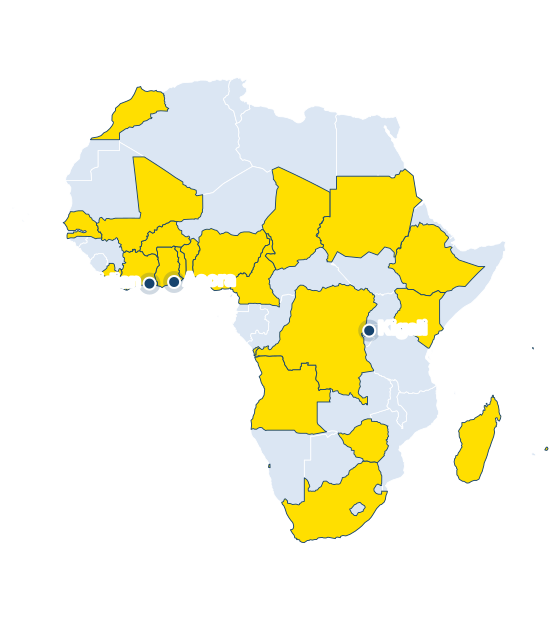
- ACEA member state
- Other African states
- AfriCircular pilot city
ACEA
Africa Circular Economy Alliance
Government-led platform hosted by the AfDB. Turns political alignment into national circular economy roadmaps.
ACEF
Africa Circular Economy Facility
Multi-donor trust fund launched in 2022 for a five-year scaling period, run by a lean internal team of four. Pairs technical assistance with investment readiness.
Proving the circular business case
Through this collaborative structure, the AfDB has moved circular financing from political intent into actual market creation, working on policy, standards, and grassroots business development at the same time.
One key example of ACEA's work is the development of a continental recycled PET standard together with the African Organization for Standardization. By creating a shared regional framework, this initiative allows businesses to collect and trade recycled materials across borders, bringing economies of scale that make recycled plastics financially viable compared to virgin plastics.
On the private sector side, ACEF launched the AfriCircular Innovators program across Kigali, Accra, Abidjan, and soon Benin, mapping local circular business models and giving them visibility. The program shows what African circularity looks like on the ground: from regenerative agriculture startups transforming organic waste into biofertilizers, to manufacturers producing packaging alternatives from agricultural waste like banana trunks or coconut husks.
Preparing pitches and providing small technical grants (such as funding a local bottle-washing line for a circular reuse business in Rwanda) is only the first step. To go beyond, ACEF has enhanced its focus toward a growth-stage cohort. This newer phase targets mature, profitable ventures to link them directly with commercial financiers to help bridge the data gap and build a clear pipeline of investable circular opportunities.
Invest hand-in-hand with strategic political intent to turn sovereign momentum into a market-wide de-risking force.
Use sovereign alignment as risk reduction
When 20 governments share a priority, financiers can de-risk whole markets, not just deals. Identify where political alignment is forming and back the infrastructure that consolidates it.
Invest in standards and platforms
Cross-border specifications, like ARSO's recycled-PET standard, unlock the economies of scale that make circular materials commercially competitive with virgin alternatives.
Bridge informal to growth-stage
Pair pipeline-building programs with growth-stage capital linkages, so mature ventures move out of the informal sector and into the investable opportunity set commercial banks can actually finance.
When a financial institution partners with public platforms to level the playing field, fixing broken value chains, establishing shared standards, opening cross-border trade, circular businesses do not have to fight their context to survive. They become investable on the same terms as any other resilient business.
Up next
All storiesTransborder upstream innovation research
How the Federal Ministry of Research, Technology and Space (BMFTR) utilizes international public research networks to shift the innovation focus from basic recycling to systemic product design.